By Admin / 26 Aug 2026
How Kinematics, Liquid Dynamics, and Production Speeds Dictate the Right Motion Profile for Your Packaging Line
- Engineering
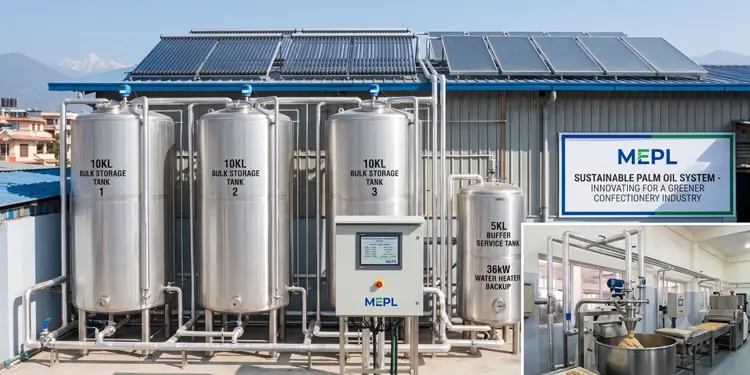
How do you efficiently handle highly temperature-sensitive raw materials—like palm oil—while keeping your plant's energy bills low?
In the food manufacturing sector, handling ingredients that change viscosity with the weather is a persistent operational challenge. At Mechatronics Engineering Pvt. Ltd. (MEPL), we thrive on solving these exact industrial puzzles. Recently, we engineered a comprehensive, semi-automated Palm Oil and Palm Olein Storage and Distribution System tailored for a major manufacturer in the biscuit and confectionery sector.
Here is a look at how we designed a smart, energy-efficient solution that balances automated process control with eco-friendly engineering.
Palm oil requires precise temperature management. If it gets too cold, it solidifies and blocks supply lines; if it is overheated, the oil degrades, compromising food quality and shelf life. Traditionally, keeping bulk oil at its optimal liquid state requires continuous, high-power electric grid heating—a method that drives up both operational costs and the plant's carbon footprint.
The goal was clear: engineer a seamless, automated distribution system that maintains the oil's exact thermal requirements while drastically reducing grid energy consumption.
Our team approached the problem by integrating green energy with smart industrial automation. Here is the engineering breakdown of the system we delivered:
To ensure an uninterrupted supply to the production floor, we designed a multi-tiered storage system:
Bulk Storage: Three 10KL bulk storage tanks hold the primary raw material.
Buffer Service Tank: A dedicated 5KL insulated buffer service tank acts as the intermediary, seamlessly feeding multiple Points of Use (POUs) across the manufacturing plant without pressure drops.
Instead of relying heavily on high-power electric grid heating, the system leverages the natural environment. We integrated an industrial Solar Hot Water system to melt and maintain the palm oil at its optimal liquid state. This drastically cuts daily power consumption. To ensure plant reliability during prolonged cloudy or critical weather conditions, a 36kW electric water heater was installed strictly as an automated backup.
To minimize manual intervention and prevent energy waste from constantly heating the bulk tanks, we implemented fully automated logic:
The system continuously monitors the real-time inventory of the 5KL buffer tank.
When the service tank volume drops below 50%, the programmable logic controller (PLC) automatically triggers the bulk storage tanks to begin thermal melting and transfer.
Once the buffer tank is replenished, the system scales back down, saving significant thermal energy.
Transferring liquid oil is only half the battle; ensuring it doesn't freeze in the transit lines is equally critical. We engineered:
Jacketed SS304 Process Piping: Complete food-grade stainless steel jacketed pipes circulate thermal fluid to eliminate line freezing and thermal shocks.
Digital Ultrasonic Level Monitoring: Provides highly accurate, non-contact volume readings for precise inventory and automated control.
Customized Dispensing Stations: Engineered at each Point of Use to ensure exact batching, eliminate material waste, and maintain hygienic standards.
By stepping back from traditional brute-force electrical heating and moving toward solar-assisted thermal management and demand-based automation, the client achieved a robust, turnkey storage and distribution system. The production floor now receives a continuous, precision-controlled supply of palm oil with zero line freezing, zero material degradation, and significantly reduced energy bills.
At Mechatronics Engineering Pvt. Ltd., we believe the best industrial solutions are those where efficiency and sustainability go hand in hand.
Are you facing material handling or automation challenges in your manufacturing facility? Contact MEPL today to learn how we can engineer a custom turnkey solution for your plant.

By Admin / 26 Aug 2026

By Admin / 24 Aug 2026

By Admin / 21 Jul 2026